
The Assyrian Empire
More than any of the early civilizations we have described so far, the Assyrians specialized in warfare.
The Assyrians had settled in the upper Tigris Valley around the city of Ashur (map blog 6) by 2000 B.C. Those Semites were peasant farmers at first, but their lands were infertile, and life was difficult. From time to time they attempted to gain more territory, but they were inevitably driven back by Hittites, Babylonians, Aramaeans or Egyptians to their old frontiers.
Forced to live vigorously, Assyria created a strong line of rulers who pursued a brutal expansion strategy. Ashur-Nasir-pal II (883-858 B.c.), to the west, routed the Arameans and conquered the Mediterranean. In the eighth and seventh centuries, he and his descendants B.c. They treated their rivals rather cruelly. Tiglath-pileser III conquered Babylon and Syria, Sargon II brought 10 of Israel's twelve tribes into captivity and Sennacherib destroyed Babylon's defiant capital. He built a new capital in Nineveh, too.
These rulers owed their prosperity to the war on a far bigger scale than their rivals had ever known. Both men were liable for military duty, and they have grouped into 10-men-by the Assyrian army; a company led by a captain formed from 5 to 20 squads. Cavalrymen and archers used to serve as mobile tanks in chariots. According to expected military strategy, the whole army fought, including reconnaissance, outflanking attacks and the battle of siege.
Assyrian engineers were turning siegecraft into a finer form. They constructed massive fortified platforms and rolled them up to city walls so that the enemy could be shot by archers on the platforms. Assyrian sapper beat down all but the stiffest walls with iron faced rams. All the Assyrian soldiers, unlike their rivals, fought with iron weapons, with tremendous results.
Whenever the Assyrians occupied a country, they rapidly formed the governing system, splitting their target communities into three groups: 1. Those who worshiped Assyria but kept their own rulers; 2. Those with an Assyrian official at their ruler's court to report his actions to Assyria; 3. Those governed by an absolute authority Governor of Assyria. The Assyrian king named all government officials and took a keen interest in building road networks that allowed him to keep in contact with his empire's outposts.
To show its power, Assyrian kings pursued massive construction schemes. As part of the 30-mile-long canal, for example, as Sennacherib extended Nineveh Town, he constructed an aqueduct that carried water to the fields around Nineveh and irrigated the botanical garden within its city walls.
The Assyrians could learn little, as soldiers, from the men they killed. Still, Babylonia influenced their society. The Assyrian king Ashurbanipal (669-631 B.C.) studied Sumerian reading and rendered a Sumerian dictionary. He kept a library of 22,000 inscribed clay tablets, including works on religious Babylonian rites, history, medicine, astronomy, and mathematics.
The reign of Ashurbanipal marked the fleeting period of Assyrian power and civilization. Weakened by revolts, Assyria eventually crumbled under the joint assaults of northeasterly Medes and southern Chaldeans. Such inhabitants defeated Nineveh completely in 612 B.C., destroying Assyria itself.
Similarly abrupt was the fall of the last two civilizations centered on Near and Middle East River Valleys. Circa 525 A.D. But under Persian attacks the regeneration of Egypt and Babylon had stalled. Consequently, the Achaemenid Kings ' Persian Empire* inherited the world's oldest civilizations.
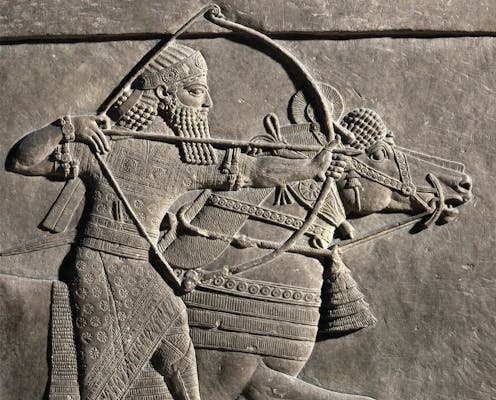 |
| King Ashurbanipal hunting lions on horseback--one of many palaces reliefs showing the peacetime pursuits of warlike Assyrians. |
More than any of the early civilizations we have described so far, the Assyrians specialized in warfare.
The Assyrians had settled in the upper Tigris Valley around the city of Ashur (map blog 6) by 2000 B.C. Those Semites were peasant farmers at first, but their lands were infertile, and life was difficult. From time to time they attempted to gain more territory, but they were inevitably driven back by Hittites, Babylonians, Aramaeans or Egyptians to their old frontiers.
Forced to live vigorously, Assyria created a strong line of rulers who pursued a brutal expansion strategy. Ashur-Nasir-pal II (883-858 B.c.), to the west, routed the Arameans and conquered the Mediterranean. In the eighth and seventh centuries, he and his descendants B.c. They treated their rivals rather cruelly. Tiglath-pileser III conquered Babylon and Syria, Sargon II brought 10 of Israel's twelve tribes into captivity and Sennacherib destroyed Babylon's defiant capital. He built a new capital in Nineveh, too.
These rulers owed their prosperity to the war on a far bigger scale than their rivals had ever known. Both men were liable for military duty, and they have grouped into 10-men-by the Assyrian army; a company led by a captain formed from 5 to 20 squads. Cavalrymen and archers used to serve as mobile tanks in chariots. According to expected military strategy, the whole army fought, including reconnaissance, outflanking attacks and the battle of siege.
Assyrian engineers were turning siegecraft into a finer form. They constructed massive fortified platforms and rolled them up to city walls so that the enemy could be shot by archers on the platforms. Assyrian sapper beat down all but the stiffest walls with iron faced rams. All the Assyrian soldiers, unlike their rivals, fought with iron weapons, with tremendous results.
 |
| Assyrian palace reliefs tell a vivid story of the ruthlessly efficient Assyrian war machine at work. Led by the King Ashur-nasirpal(the bearded archer protected by shield and umbrella), Assyrian spearman backed by archers storms a city's walls. Meanwhile, Assyrian engineers undermine walls. |
Whenever the Assyrians occupied a country, they rapidly formed the governing system, splitting their target communities into three groups: 1. Those who worshiped Assyria but kept their own rulers; 2. Those with an Assyrian official at their ruler's court to report his actions to Assyria; 3. Those governed by an absolute authority Governor of Assyria. The Assyrian king named all government officials and took a keen interest in building road networks that allowed him to keep in contact with his empire's outposts.
To show its power, Assyrian kings pursued massive construction schemes. As part of the 30-mile-long canal, for example, as Sennacherib extended Nineveh Town, he constructed an aqueduct that carried water to the fields around Nineveh and irrigated the botanical garden within its city walls.
The Assyrians could learn little, as soldiers, from the men they killed. Still, Babylonia influenced their society. The Assyrian king Ashurbanipal (669-631 B.C.) studied Sumerian reading and rendered a Sumerian dictionary. He kept a library of 22,000 inscribed clay tablets, including works on religious Babylonian rites, history, medicine, astronomy, and mathematics.
The reign of Ashurbanipal marked the fleeting period of Assyrian power and civilization. Weakened by revolts, Assyria eventually crumbled under the joint assaults of northeasterly Medes and southern Chaldeans. Such inhabitants defeated Nineveh completely in 612 B.C., destroying Assyria itself.
Similarly abrupt was the fall of the last two civilizations centered on Near and Middle East River Valleys. Circa 525 A.D. But under Persian attacks the regeneration of Egypt and Babylon had stalled. Consequently, the Achaemenid Kings ' Persian Empire* inherited the world's oldest civilizations.
ConversionConversion EmoticonEmoticon